11+ Maths exam │ Bond 11+
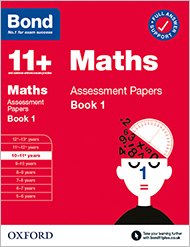
Find out more about the 11+ Bond maths exam and how Bond 11+ maths papers and resources can support your child on their path to exam success.
How to help your child prepare for the 11+ in Year Four11+ Bond maths exam overview
11+ maths papers and tests cover a broad spectrum of maths principles and concepts. They examine how effectively a child can understand and manipulate numbers.
Although 11+ maths exams vary from region to region these are the key topics that your child will be tested on:
- The ability to think and calculate quickly
- Sound knowledge of multiplication tables
- The ability to apply the four number operations (+ - x ÷) accurately
- A fundamental understanding of number relationships, measurement, mental arithmetic, geometry and data handling
There are two different formats for 11 plus maths exam papers:
11+ maths exam format:
- Standard format – where children write their answers on the test paper
- Multiple-choice format – where answers are marked in a separate answer booklet
11+ maths exam papers are timed and usually last between 45-60 minutes. Children should practise with timed 11+ mock test papers, as well as working through non-timed practice, so they can see what they are able to do within a given time frame.
Bond 11+ maths resources
Bond is the number 1 provider of 11+ practice materials, helping millions of children pass selective entrance exams. Offering a comprehensive learning programme for the 11+, we have a wide range of resources to support you and your child:
Bond Assessment Maths Papers
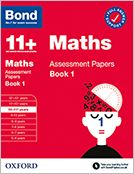
Topic-based practice questions that set the foundation for success. These carefully-graded practice papers provide essential practice for each question type in a realistic exam style. Ages 5-13+
Now with fully explained maths answers (for ages 9-11)
Bond 11+ Maths Handbook
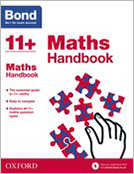
Step-by-step guidance for developing the skills needed for the 11+ maths exam and other entrance tests. With clear explanations and worked examples of all 11+ maths question types.
Practical support for parents and children aged 8-11+
Bond CEM 11+
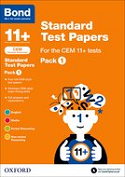
Developed specifically for the CEM 11+ exam, we’ve created a range of materials to help you prepare your child for the CEM 11+ exam, including assessment papers, test papers and learning guides. Ages 8-11+
Bond Test Papers
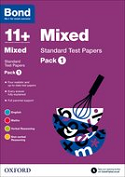
Bond 11+ test paper packs enable realistic mock exam practice at home, which includes maths practice papers, with answers, matching the style, content and difficulty of the real 11+ examination. Ages 7-11
Bond 10 Minute Tests
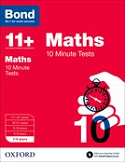
Bite-sized tests for quick practice and revision, including coverage of all the core skills and motivating and fun puzzle selections. Ages 7-12+
Bond Online

Used by thousands of parents and children every year, Bond Online gives your child unlimited access to thousands of 11+ questions and is a fun and engaging way of helping your child prepare for the 11+. Age 9+
The Parents' Guide to the 11+
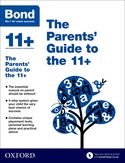
The essential manual for all parents whose children are about to embark on their 11+ exam journey. Written by an experienced 11+ tutor, this guide offers a practical 4-step approach to guide you through the entire process.
Tips for parents
Here are some ideas for you to try at home with Bond 11+ maths materials in order to help your child prepare for their 11+ maths exam.
Year 4 – check up on basic skills during the summer term and use the summer holidays to:
- Consolidate times tables and number bonds
- Practise halving and doubling numbers
- Become familiar with different types of measurement through activities such as cooking
Year 5 – this is the time to start regular 11+ revision and practice. Support your child by:
- Establishing a regular routine of practising times tables. Introduce a couple of quiet, uninterrupted sessions a week for practice.
- Practising maths skills little and often, with an emphasis on quick thinking and rapid feedback. In 11+ maths, children are expected to show dexterity in manipulating numbers and the ability to solve problems of all kinds logically.
- Focusing on areas of difficulty, consolidating skills and developing time management skills. Your child should be covering all aspects of maths that he or she will need for the 11+ exam at school so focus on these three additional areas at home.
Free resources
- Sign up to the Bond website and download free 11+ resources, including activity sheets and assessment papers
11+ Verbal Reasoning exam │ Bond 11+
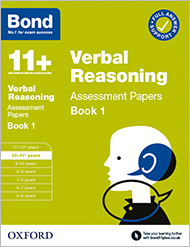
Find out more about the 11+ verbal reasoning exam and how Bond 11+ verbal reasoning resources can support your child on their path to exam success.
11+ verbal reasoning exam overview
11+ Verbal Reasoning exam overview
Verbal reasoning tests assess children’s problem solving skills when working at speed, and also test how effectively they can process information.
Verbal reasoning is not part of the National Curriculum in state primary schools, and this style of assessment may feel quite strange for children who have not seen questions framed in this way before. This is why practising these kinds of questions at home is so important: it helps familiarise children with a style of testing that they won’t experience at school.
The scope and content of an 11+ verbal reasoning exam differs from region to region as there are a wide range of question types that can be included. However, the tests will usually require children to:
- Process verbal information
- Apply logical thinking and problem-solving skills
- Find and follow patterns and rules
- Determine word meaning
- Spell accurately
- Apply basic maths skills
- Work systematically
There are two different formats for 11+ verbal reasoning exam papers:
- Standard format – where children write their answers on the test paper
- Multiple-choice format – where answers are marked in a separate answer booklet
11+ verbal reasoning exam papers are timed and usually last between 45-60 minutes. Children should practise with timed 11+ mock test papers, as well as working through non-timed practice, so they can see what they are able to do within a given time frame.
Bond 11+ Verbal Reasoning resources
Bond is the number 1 provider of 11+ practice materials, helping millions of children pass selective entrance exams. Offering a comprehensive learning programme for the 11+, we have a wide range of resources to support you and your child:
Bond Assessment Papers
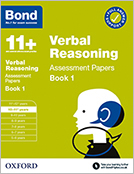
Topic-based practice questions that set the foundation for success. These carefully-graded practice papers provide essential practice for each question type in a realistic exam style. Ages 5-13+
Now with fully explained answers (for ages 9-11)
Bond 11+ Verbal Reasoning Handbook
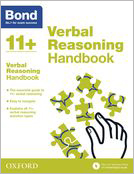
Step-by-step guidance for developing the skills needed for the 11+ verbal reasoning exam and other entrance tests. With clear explanations and worked examples of all 11+ verbal reasoning question types.
Practical support for parents and children aged 8-11+
Bond CEM 11+
Developed specifically for the CEM 11+ exam, we’ve created a range of materials to help you prepare your child for the CEM 11+ exam, including assessment papers, test papers and learning guides. Ages 8-11+
Bond Test Papers
Bond 11+ test paper packs enable realistic mock exam practice at home, matching the style, content and difficulty of the real 11+ examination. Ages 7-11
Bond 10 Minute Tests
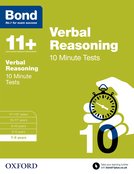
Bite-sized tests for quick practice and revision, including coverage of all the core skills and motivating and fun puzzle selections. Ages 7-12+
Bond Online
Used by thousands of parents and children every year, Bond Online gives your child unlimited access to thousands of 11+ questions and is a fun and engaging way of helping your child prepare for the 11+. Age 9+
The Parents' Guide to the 11+
The essential manual for all parents whose children are about to embark on their 11+ exam journey. Written by an experienced 11+ tutor, this guide offers a practical 4-step approach to guide you through the entire process.
Tips for parents
Verbal reasoning is not taught as part of the National Curriculum in state schools so it’s important to practise these kinds of questions at home. This will build your child’s confidence and help familiarise them with a style of testing that they won’t experience at school.
Here are some ideas for you to try at home in order to help your child prepare for their verbal reasoning 11+ exam.
Year 4 – check up on basic skills during the summer term and use the summer holidays to develop logical thinking and problem solving skills.
- Play word games such as Scrabble® and complete crosswords to improve your child’s word knowledge
- Play dictionary games and encourage your child to create anagrams to improve their word sorting skills and test their knowledge of the alphabet
- Use logic puzzle books and complete numerical problems such as Sudoku to test verbal and numerical logic
Year 5 – this is the time to start regular 11+ revision and practice. Support your child by:
- Establishing a regular weekly routine for practice – little and often is usually best
- Playing word games to further develop their knowledge of vocabulary and synonyms, as well as their logical thinking skills. Suggest a word to your child and ask them to find a word that is opposite then similar to it, or a game where you suggest a pair of words and your child tried to find the common link.
Free resources
- Sign up to the Bond website and download free 11+ resources, including activity sheets and assessment papers
11+ Non-verbal Reasoning and Spatial Awareness exam │ Bond 11+
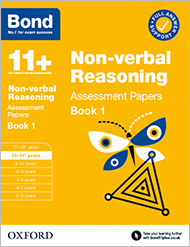
Find out more about the 11+ non-verbal reasoning exam (referred to as 'spatial awareness' in some local authorities or schools) and how Bond 11+ non-verbal reasoning resources can support your child on their path to exam success.
11+ non-verbal reasoning and spatial awareness exam overview
Bond 11+ non-verbal reasoning and spatial awareness resources
11+ Non-verbal Reasoning/Spatial Awareness exam overview
11+ non-verbal reasoning/spatial awareness is often used as a neutral way of testing aptitude levels in children. It does not require any prior knowledge and can be used to determine a candidate's potential to think logically and recognise patterns.
Non-verbal reasoning/spatial awareness is not part of the National Curriculum in state primary schools, and this style of assessment may feel quite strange for children who have not seen questions framed in this way before. This is why practising these kinds of questions at home is so important: it helps familiarise children with a style of testing that they won’t experience at school.
The scope and content of an 11+ non-verbal reasoning/spatial awareness exam differs from region to region as there are a wide range of question types that can be included. In addition, it is important to establish if non-verbal reasoning/spatial awareness is tested by the Local Authority (LA) that administers the 11+ in your area, as not every LA tests this subject.
If non-verbal reasoning/spatial awareness is one of the subjects your child will be tested on as part of the 11+, the non-verbal reasoning/spatial awareness exam will usually require children to:
- Process graphic or pictorial information
- Apply logical thinking and problem-solving skills
- Use spatial awareness – how objects relate to each other in space
- Find and follow patterns and rules
- Apply maths skills – rotation, reflection and symmetry
- Work systematically
There are two different formats for 11+ non-verbal reasoning/spatial awareness exam papers:
- Standard format – where children write their answers on the test paper
- Multiple-choice format – where answers are marked in a separate answer booklet
11+ non-verbal reasoning/spatial awareness exam papers are timed and usually last between 45-60 minutes. Children should practise with timed 11+ mock test papers, as well as working through non-timed practice, so they can see what they are able to do within a given time frame.
Bond 11+ Non-verbal Reasoning/Spatial Awareness resources
Bond is the number 1 provider of 11+ practice, helping millions of children pass selective entrance exams. Offering a comprehensive learning programme for the 11+, we have a wide range of resources to support you and your child:
Bond Assessment Papers
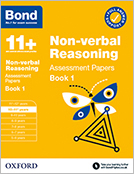
Topic-based practice questions that set the foundation for success. These carefully-graded practice papers provide essential practice for each question type in a realistic exam style. Ages 5-13+
Bond 11+ Non-verbal Reasoning Handbook
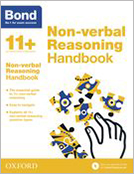
Step-by-step guidance for developing the skills needed for the 11+ non-verbal reasoning exam and other entrance tests. With clear explanations and worked examples of all 11+ non-verbal reasoning question types.
Practical support for parents and children aged 8-11+
Bond CEM 11+
Developed specifically for the CEM 11+ exam, we’ve created a range of materials to help you prepare your child for the CEM 11+ exam, including assessment papers, test papers and learning guides. Ages 8-11+
Bond Test Papers
Bond 11+ test paper packs enable realistic mock exam practice at home, matching the style, content and difficulty of the real 11+ examination. Tutor tips for exam success are included, written by leading 11+ tutors and packed with advice to help gain extra marks. Ages 7-11
Bond 10 Minute Tests
Bite-sized tests for quick practice and revision, including coverage of all the core skills and motivating and fun puzzle selections. Ages 7-12+
Bond Online
Used by thousands of parents and children every year, Bond Online gives your child unlimited access to thousands of 11+ questions and is a fun and engaging way of helping your child prepare for the 11+. Age 9+
The Parents' Guide to the 11+
The essential manual for all parents whose children are about to embark on their 11+ exam journey. Written by an experienced 11+ tutor, this guide offers a practical 4-step approach to guide you through the entire process.
Tips for parents
Non-verbal reasoning/spatial awareness is not taught as part of the National Curriculum in state schools so it’s important to practise these kinds of questions at home. This will build your child’s confidence and help familiarise them with a style of testing that they won’t experience at school.
Here are some ideas for you to try at home in order to help your child prepare for their non-verbal reasoning/spatial awareness 11+ exam.
Year 4 – check up on basic skills during the summer term and use the summer holidays to develop logical thinking and problem solving skills:
- Use tile shape patterns and jigsaw puzzles, either real or online, to help your child recognise patterns and shapes
- Play spot the difference games to reinforce their visual understanding
Year 5 – this is the time to start regular 11+ revision and practice. Support your child by:
- Establishing a regular weekly routine for practice – little and often is usually best
- Ensuring they work through some test papers to get used to both the question types and the exam timings
Free resources
- Sign up to the Bond website and download free 11+ resources, including activity sheets and assessment papers
11 plus English exam │ Bond 11+
Find out more about the 11+ English exam and how Bond 11+ English practice papers and resources can support your child on their path to exam success.
11+ English exam overview
Although 11+ English exams vary from region to region these are the key topics that your child will be tested on:
- 11 plus english sample papers, comprehension practice papers, where children have to read pieces of text and answer questions on them
- 11+ writing tasks, where children have to write something themselves
- Punctuation and grammar problems, where children show their understanding of how English works as a language
- Spelling tasks, where children spot incorrect spellings
There are two different formats for 11 plus English exam papers:
- Standard format – where children write their answers on the test paper
- Multiple-choice format – where answers are marked in a separate answer booklet
11+ English exam papers are timed and usually last between 45-60 minutes. Children should practise with timed 11+ mock test papers, as well as working through non-timed practice, so they can see what they are able to do within a given time frame.
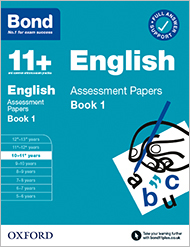
Bond 11+ English Assessment Papers
Bond Assessment Papers
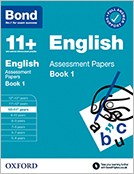
Topic-based practice questions that set the foundation for success. These carefully-graded practice papers provide essential practice for each question type in a realistic exam style. Ages 5-13+
Now with fully explained answers (for ages 9-11)
11+ English Handbook
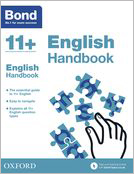
Step-by-step guidance for developing the skills needed for the 11+ English exam and other entrance tests. With clear explanations and worked examples of all 11+ English question types.
Practical support for parents and children aged 8-11+
Bond CEM 11+
Developed specifically for the CEM 11+ exam, we’ve created a range of materials to help you prepare your child for the CEM 11+ exam, including assessment papers, test papers and learning guides. Ages 8-11+
Bond Test Papers
Bond 11+ test paper packs enable realistic mock exam practice at home, matching the style, content and difficulty of the real 11+ examination. Tutor tips for exam success are included, written by leading 11+ tutors and packed with advice to help gain extra marks. Ages 7-11
Bond 10 Minute Tests
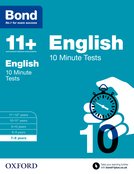
Bite-sized tests for quick practice and revision, including coverage of all the core skills and motivating and fun puzzle selections. Ages 7-12+
Bond Online
Used by thousands of parents and children every year, Bond Online gives your child unlimited access to thousands of 11+ questions and is a fun and engaging way of helping your child prepare for the 11+. Age 9+
The Parents' Guide to the 11+
The essential manual for all parents whose children are about to embark on their 11+ exam journey. Written by an experienced 11+ tutor, this guide offers a practical 4-step approach to guide you through the entire process.
Tips for parents
Here are some ideas for you to try at home in order to help your child prepare for their 11plus English exam and grammar schools.
Year 4 – check up on basic skills during the summer term and use the summer holidays to:
- Ensure your child is reading regularly. Reading is a key skill so spend time reading with your child during the summer. Ask them to explain what they’re reading so you can gauge their comprehension skills.
- Keep a diary or write a summer project to help your child improve their writing skills. Use this opportunity to develop their vocabulary and spelling skills.
- Use quizzes, dictionary games and crosswords to further extend your child’s knowledge.
Year 5 – this is the time to start regular 11+ revision and practice. Support your child by:
- Establishing a regular routine of bedtime reading, if that’s not already part of your child’s life. Encourage a wide range of reading material to ensure your child is exposed to a variety of authors and styles as this will help to build their vocabulary. As well as factual books and fiction you might want to include diaries and newspapers written especially for children.
- Planning some quiet, uninterrupted reading and writing sessions each week. Aim for one reading and one writing session per week, although you might want to do more if English is your child’s weaker subject.
Free resources
- Sign up to the Bond website and download free 11+ resources, including activity sheets and assessment papers